Burst Fade Types: Complete Guide to All 5 Variations (2025)

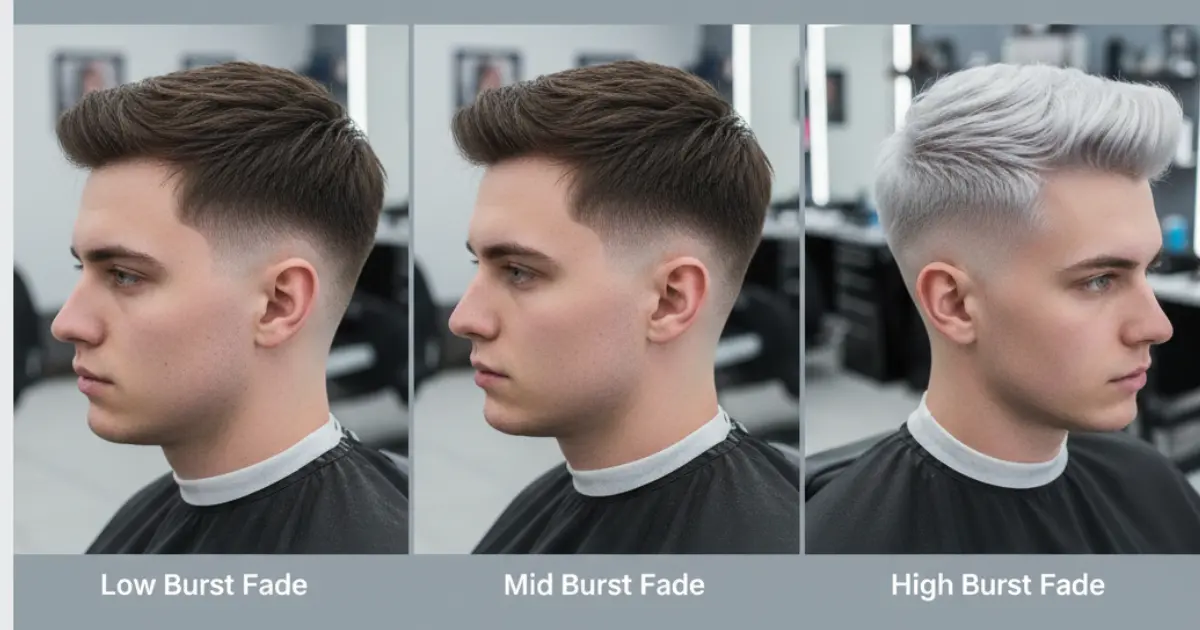
Burst fade types differ by height placement, creating distinctly different looks with varying maintenance requirements. After 15 years cutting fades, I’ve learned that low burst fades start above the ear (lasting 3-4 weeks), mid burst fades begin at temple level (2-3 weeks), and high burst fades start near the crown (1-2 weeks). Each type creates different contrast levels, suits specific face shapes, and requires different upkeep commitments.
Understanding what a burst fade is provides the foundation, but knowing which type matches your hair texture, maintenance willingness, and style goals determines whether your fade looks sharp or grown out. A 2024 barbershop survey found that 68% of clients choose mid burst fades for their balance of definition and maintenance, while high fades suit bold personalities and low fades work for conservative environments.
The curved, semi-circular shape remains consistent across all burst fade types, but where that curve starts dramatically changes the final appearance and how often you’ll need barber visits.
TL;DR: Burst Fade Types
- Main types: Low, mid, high, burst taper, and burst skin fade
- Low burst fade: Starts above ear, subtle, lasts 3-4 weeks
- Mid burst fade: Begins at temples, balanced, lasts 2-3 weeks
- High burst fade: Starts near crown, dramatic, lasts 1-2 weeks
- Burst taper: Doesn’t fade to skin, softer, lasts 3-4 weeks
- Cost: Same haircut price, but frequency affects total cost
- Best for beginners: Mid burst fade offers versatility
Low Burst Fade
The low burst fade starts just above the ear, creating a subtle curved arc that drops toward the neckline. This conservative variation exposes minimal skin while maintaining the burst fade’s distinctive semi-circular shape.
The fade begins approximately 1-2 inches above your ear’s top point, curving gently around the ear and tapering down the neck. Because the transition starts low, the contrast between your top length and faded sides remains understated.
Maintenance schedule: 3-4 weeks between barber visits. The low starting point means hair growth doesn’t immediately destroy the fade’s shape. You can stretch to 5 weeks if maintaining a professional appearance isn’t critical.
Best for: Business professionals, conservative environments, first-time fade wearers, and anyone wanting modern edge without bold statements. Low burst fades suit most face shapes because the subtle placement doesn’t dramatically alter your head’s proportions.
Hair texture considerations: Works excellently with all textures. Curly hair masks regrowth particularly well with low burst fades, potentially extending to 4-5 weeks between cuts. Straight hair shows definition clearly without becoming too aggressive.
Styling approach: Low burst fades pair well with classic hairstyles. Comb overs, side parts, textured crops, and neat quiffs all complement the understated fade. The low placement keeps attention on your top styling rather than the fade itself.
The conservative nature of low burst fades makes them office-appropriate while still delivering contemporary barbering technique. You get modern style without HR concerns.
Mid Burst Fade
The mid burst fade starts at temple level, approximately where your sideburn ends and your hair begins transitioning upward. This placement creates balanced contrast between your top length and faded sides.
Starting at the temple provides that sweet spot between subtlety and boldness. The fade curves around the ear in the signature semi-circular pattern, creating noticeable definition without the high-maintenance demands of higher placements.
Maintenance schedule: 2-3 weeks between barber appointments. The temple-level start means regrowth becomes visible around day 14, though the fade doesn’t look dramatically overgrown until week 3.
Best for: Most men seeking versatile, modern fades. Mid burst fades work for both professional and casual settings. They suit oval, square, and heart-shaped faces particularly well because the temple placement creates visual balance.
Hair texture considerations: Mid burst fades excel across all textures. Wavy hair blends beautifully with the mid-level curve, straight hair showcases crisp lines, and curly hair gains structured definition while maintaining volume.
Styling versatility: Mid burst fades complement nearly any top style. Mohawks, textured crops, swept fringes, pompadours, and even longer flowing styles all work. The balanced placement doesn’t compete with your top styling choices.
This versatility explains why mid burst fades dominate barbershops. Clients get noticeable style without committing to aggressive maintenance or limiting their styling options.
Face shape optimization: Round faces benefit from mid burst fades because the temple-level start creates vertical lines that elongate. Square faces find the curved shape softens angular jaws. Long faces gain width from the horizontal arc.
Mid burst fades represent the default recommendation for most clients because they rarely disappoint. Starting here lets you evaluate fade life before committing to more dramatic variations.
High Burst Fade
The high burst fade starts near the crown, 3-4 inches above your ear, creating maximum contrast between your top length and the tightly faded sides. This dramatic placement makes the curved arc highly visible and statement-making.
The fade curves from the upper temple area, arcing around the ear with sharp definition before dropping to the neckline. Because so much hair transitions from long to short, the visual impact becomes bold and unmissable.
Maintenance schedule: 1-2 weeks between barber visits. High burst fades show regrowth quickly because the dramatic contrast makes even slight hair growth obvious. Plan on weekly or bi-weekly appointments for consistent sharpness.
Best for: Bold personalities, fashion-forward individuals, younger demographics comfortable with frequent barbershop visits, and anyone wanting maximum attention-grabbing style. High burst fades work best for oval and diamond face shapes that can handle the dramatic contrast.
Hair texture considerations: High burst fades work across textures but demand more from your hair. Thick, coarse hair holds the shape well despite aggressive fading. Fine hair may struggle because the high placement removes significant bulk, potentially making your head appear small.
Curly hair creates striking definition with high burst fades, the tight curls on top contrasting dramatically with clean sides. Straight hair delivers the crispest, sharpest lines but also shows regrowth fastest.
Styling requirements: High burst fades demand substantial top length to balance the aggressive sides. Minimum 3-4 inches on top prevents your head from looking disproportionate. Mohawks, faux hawks, voluminous textured styles, and pompadours all complement high placement.
The maintenance commitment represents the primary drawback. Weekly cuts at $30-50 each total $1,560-2,600 annually just for fade upkeep. Budget accordingly before committing to high burst fades.
When to choose high over mid: If you genuinely enjoy frequent barbershop visits, want maximum visual impact, don’t mind higher grooming costs, and your lifestyle supports bold styling. High burst fades aren’t practical maintenance choices but style statements.
Burst Taper Fade
The burst taper fade blends burst fade’s curved arc with taper technique’s softer transition. Instead of fading completely to skin, the taper maintains short hair length throughout, creating a more natural, less aggressive appearance.
The curved shape remains the same semi-circular arc around the ear, but the gradient stops at approximately 1/8 to 1/4 inch rather than bare skin. This produces subtle definition without stark contrast.
Maintenance schedule: 3-4 weeks between cuts. The taper’s gradual nature means regrowth doesn’t immediately destroy the style. You gain similar longevity to low burst fades while maintaining the burst’s distinctive shape.
Best for: Professionals in conservative fields, men preferring subtle styling, those new to fades wanting a gentler introduction, and anyone seeking lower maintenance without sacrificing modern technique. Burst taper fades work exceptionally well for men over 40 who want contemporary style without youth-targeting boldness.
Hair texture benefits: Burst taper fades excel with curly, wavy, and textured hair because the retained length blends naturally with your hair’s movement. The softer transition complements natural texture better than skin-tight fading.
For those exploring related options, the mid taper fade offers similar subtle definition with traditional taper placement rather than the burst’s curved shape.
Visual difference from skin fades: Standing 5 feet away, burst taper fades appear softer and more natural than burst skin fades. The maintained length creates shadows and dimension rather than stark light-to-dark contrast. This subtlety appeals to conservative dressers and mature men.
Styling approach: Burst taper fades pair beautifully with classic gentleman’s styles. Slicked backs, neat side parts, textured brushbacks, and conservative crops all complement the refined aesthetic. You get modern barbering without aggressive edge.
The combination of curved burst shaping with taper’s gradual approach creates a sophisticated middle ground between traditional tapers and contemporary skin fades.
Burst Skin Fade
The burst skin fade takes the curved arc completely down to bare skin, creating maximum possible contrast and the sharpest visual definition. This represents the most aggressive burst fade variation.
Your barber fades from your top length down through various guard sizes, finishing with razor or trimmer work that removes all visible hair. The skin-level finish makes the curved burst shape dramatically obvious.
Maintenance schedule: 1-2 weeks between appointments. Burst skin fades show regrowth immediately because bare skin provides maximum contrast. Even 3-4 days of growth becomes noticeable as stubble appears along the fade line.
Best for: Bold style seekers, younger demographics, fashion-forward individuals, and anyone comfortable with high-maintenance grooming. Burst skin fades work best when your lifestyle supports frequent barbershop visits and you genuinely enjoy the grooming ritual.
Height variation: Burst skin fades can be low, mid, or high, combining placement height with skin-level finishing. A low burst skin fade offers more moderation than a high burst skin fade, though both fade to skin rather than retaining length.
Texture considerations: Burst skin fades work across all textures but show different characteristics. Curly and coily hair creates the most striking definition because the tight texture on top contrasts dramatically with smooth skin. Straight hair delivers the cleanest, crispest fade lines but requires perfect execution to avoid visible imperfections.
Visual impact: Burst skin fades photograph exceptionally well because the extreme contrast creates clear definition in images. This explains their popularity on social media and among younger demographics comfortable with bold styling.
Cost reality: Weekly maintenance at $35-50 per cut totals $1,820-2,600 annually. Add tips and you’re approaching $3,000 yearly just for fade maintenance. Factor this commitment before choosing burst skin fades over less aggressive options.
Burst Fade vs Other Fade Styles
Understanding how burst fades compare to other fade techniques helps you determine if the curved, semi-circular shape suits your needs better than alternatives.
Burst fade vs drop fade: Drop fades follow your head’s natural curve, dropping lower behind the ear and continuing along the neckline. Burst fades curve around the ear but stop at the neck’s side rather than following the entire back.
Drop fades create a more natural, flowing transition. Burst fades deliver bolder, more geometric shaping. Drop fades suit conservative styling, burst fades work for statement-making looks.
Burst fade vs traditional fade: Standard fades blend straight across from front to back, creating even transitions around your entire head. Burst fades focus the curved shape specifically around the ears, leaving more length at the back.
Traditional fades offer uniform appearance. Burst fades create intentional asymmetry that pairs with mohawks, mullets, and other styles maintaining back length.
Burst fade vs temple fade: Temple fades concentrate on the temple area only, leaving the back and lower sides longer. Burst fades extend the curved arc from temple through the full ear circumference.
Temple fades work for afros, locs, and styles requiring significant back length. Burst fades provide more complete side shaping.
Maintenance comparison: Traditional fades last 2-3 weeks, drop fades 2-4 weeks, temple fades 3-4 weeks, and burst fades 1-4 weeks depending on type. The curved burst shape shows regrowth differently than straight fades, typically requiring slightly more frequent maintenance for equivalent sharpness.
Best Burst Fade Type for Your Hair Texture
Hair texture significantly influences which burst fade type delivers optimal results and manageability.
Straight hair: Mid to high burst fades work best because they create definition straight hair often lacks. Low burst fades risk appearing too subtle on straight texture. The clean lines of straight hair showcase burst fades beautifully but also reveal imperfect blending instantly.
Request slightly more texture on top when getting burst fades with straight hair. The textured contrast helps prevent your head from appearing too geometric or harsh.
Wavy hair: All burst fade types complement wavy texture. The natural movement in wavy hair softens aggressive fades while enhancing subtle ones. Mid burst fades particularly suit wavy hair because the temple-level placement lets waves flow naturally on top while the curve adds structure to sides.
Curly hair: Low to mid burst fades work excellently with curly hair because the curl pattern masks regrowth, extending time between cuts. High burst fades create dramatic definition but require more top length to balance the aggressive sides.
For detailed curly-specific guidance, see our burst fade for curly hair guide covering products, maintenance, and styling techniques.
Coily/kinky hair: Mid to high burst fades deliver striking results on coily hair because the tight curl pattern creates maximum contrast with faded sides. The density of coily hair holds burst fade shapes longer than finer textures.
Low burst fades risk insufficient definition on very coily hair because the tight curls partially obscure the fade arc. Starting at mid-level ensures the curve remains visible.
Specialized considerations for burst fade on African American hair include moisture maintenance, preventing razor bumps, and choosing appropriate clipper techniques for coily texture.
Fine/thin hair: Burst taper fades or low burst fades work best because aggressive high fading removes too much bulk, potentially making thin hair appear even thinner. The retained length in tapers and low fades maintains visual fullness.
Thick/dense hair: All burst fade types work well with thick hair because you have volume to spare. High burst fades particularly suit thick hair, the dramatic removal creating welcome contrast against substantial top length.
Choosing Your Burst Fade Type by Face Shape
Face shape determines which burst fade type creates the most flattering proportions and visual balance.
Round faces: Mid to high burst fades elongate round faces by creating vertical visual lines. The temple-level or higher start draws eyes upward, making your face appear longer. Avoid low burst fades that emphasize roundness.
Pair burst fades with height on top. Pompadours, textured quiffs, and vertical styling further elongate round face shapes.
Oval faces: Any burst fade type works because oval faces have balanced proportions. Choose based on maintenance willingness and style preferences rather than face shape concerns. Oval faces represent the most versatile shape for experimenting with different burst fade variations.
Square faces: Low to mid burst fades soften angular jawlines because the curved arc contrasts with square edges. The rounded shape adds gentleness to strong, masculine features. High burst fades risk emphasizing squareness by creating additional angular lines.
Long/rectangular faces: Low burst fades work best because they don’t add vertical emphasis that further elongates your face. The subtle curve creates horizontal visual interest that balances length. Avoid high burst fades that draw eyes upward, exaggerating face length.
Heart-shaped faces: Mid burst fades balance wider foreheads because the temple-level placement creates visual width at your face’s narrower lower half. The curved shape also softens the transition from wider forehead to narrower chin.
Diamond faces: Low to mid burst fades complement strong cheekbones by adding curved softness around the ears and temples. The burst shape’s roundness balances angular cheekbone prominence.
When uncertain about your face shape, start with mid burst fades. The balanced temple-level placement flatters most shapes while letting you evaluate how burst fades work with your features before committing to more extreme variations.
Maintenance Requirements by Burst Fade Type
Understanding maintenance commitments before choosing your burst fade type prevents disappointment and overspending.
Low burst fade maintenance:
- Professional cuts: Every 3-4 weeks
- At-home edge cleanup: Weekly neckline and sideburn trimming
- Annual barber visits: 13-17 appointments
- Annual cost at $35/cut: $455-595 plus tips
Mid burst fade maintenance:
- Professional cuts: Every 2-3 weeks
- At-home edge cleanup: Every 5-7 days around temples and neckline
- Annual barber visits: 17-26 appointments
- Annual cost at $35/cut: $595-910 plus tips
High burst fade maintenance:
- Professional cuts: Every 1-2 weeks
- At-home edge cleanup: Every 3-5 days minimum
- Annual barber visits: 26-52 appointments
- Annual cost at $35/cut: $910-1,820 plus tips
Burst taper fade maintenance:
- Professional cuts: Every 3-4 weeks
- At-home edge cleanup: Weekly for neat appearance
- Annual barber visits: 13-17 appointments
- Annual cost at $35/cut: $455-595 plus tips
Burst skin fade maintenance:
- Professional cuts: Every 1-2 weeks regardless of height
- At-home edge cleanup: Every 2-4 days for sharp appearance
- Annual barber visits: 26-52 appointments
- Annual cost at $35/cut: $910-1,820 plus tips
These costs assume basic fade pricing. Specialty barbers, major cities, and added services (beard trim, designs) increase per-visit costs significantly. A $50/cut high burst fade totals $2,600 annually.
Between-visit maintenance: All burst fade types benefit from at-home edge cleanup using quality trimmers. Focus on neckline, sideburns, and the area behind ears where regrowth appears first. Never attempt to recreate the actual burst arc at home unless you have professional training.
Product investment: Budget $20-40 monthly for styling products maintaining your burst fade. Texture clays, matte pastes, and light-hold creams keep your top styled while the clean sides showcase the fade.
Common Mistakes When Choosing Burst Fade Types
Choosing high fades without considering maintenance: The most common error involves selecting high burst fades for their bold appearance without budgeting time and money for weekly barbershop visits. High fades look incredible fresh but deteriorate quickly.
Start with mid burst fades, evaluate your actual maintenance willingness, then consider high fades after experiencing real-world upkeep demands.
Ignoring face shape guidance: Round-faced clients requesting low burst fades often feel disappointed because the subtle placement emphasizes rather than balances their face shape. Similarly, long-faced clients choosing high fades elongate their faces further.
Consult your barber about face shape optimization before committing to specific types.
Mismatching fade type with lifestyle: Professional environments requiring conservative appearance struggle with high burst fades. Active lifestyles without time for frequent barbershop visits clash with skin fades’ demands. Match your fade type to your actual daily life, not idealized versions.
Requesting burst fades with insufficient top length: Burst fades require adequate top length to balance the faded sides, particularly high variations. Minimum 2-3 inches on top for low burst fades, 3-4 inches for mid, and 4-5 inches for high fades prevents disproportionate appearance.
Expecting burst fades to fix bad haircuts: Burst fades enhance good haircuts but don’t salvage poor top styling. The fade represents your haircut’s foundation, not its entirety. Ensure your top style works before adding burst fades.
Switching types too frequently: Changing burst fade types monthly prevents your barber from perfecting your specific cut. Stick with one type for 3-4 visits before evaluating alternatives. This consistency lets you genuinely assess whether the type suits your needs.
How to Ask Your Barber for Specific Burst Fade Types
Clear communication ensures you receive your desired burst fade variation rather than your barber’s interpretation.
Use specific terminology: Say “I want a mid burst fade starting at temple level” rather than “give me a burst fade.” The height specification eliminates guesswork. Barbers recognize low, mid, and high as standard terminology.
Clarify skin vs taper: Specify whether you want the fade going to skin or maintaining length. “Mid burst skin fade” versus “mid burst taper fade” clearly communicates your preference. Don’t assume your barber knows your intention.
Discuss guard sizes: Mention if you want specific guard sizes at the fade’s top point. “Start the fade at a #3 and blend to skin” provides technical precision. Most burst fades begin at #2 or #3, but customization works if you want more or less top contrast.
Bring reference photos: Show 2-3 images of the specific burst fade type you want, noting which aspects you like. “I like how this mid burst curves” or “I want this amount of skin showing” gives visual context words can’t provide.
Describe your maintenance willingness: Tell your barber “I can only visit every 3 weeks” or “I don’t mind weekly appointments.” This honesty lets them recommend the most practical type for your schedule.
Mention your top style: Explain what you’re planning on top. “I’m growing the top for a pompadour” or “I want a textured crop” helps your barber determine which burst fade type complements your overall look.
Ask for professional input: After explaining your preferences, ask “What burst fade type do you recommend for my face shape and hair texture?” Skilled barbers provide valuable guidance based on technical expertise.
Start conservative: If uncertain between two types, choose the less aggressive option first. You can always go higher/bolder next visit, but you can’t un-cut a too-high fade.
Popular Burst Fade Type Combinations
Specific top styles pair naturally with certain burst fade types, creating cohesive looks rather than disconnected elements.
Mohawk with mid-to-high burst fade: The mohawk’s centered strip of length demands substantial side contrast. Mid burst fades provide adequate definition for subtle mohawks, while high burst fades suit dramatic mohawk styling.
Mullet with low-to-mid burst fade: Mullets maintain significant back length, making burst fades ideal because they preserve that length while adding side definition. Low to mid burst fades balance the mullet’s business-in-front, party-in-back aesthetic without overwhelming it.
Textured crop with mid burst fade: The textured crop’s casual, piece-y styling pairs perfectly with mid burst fades’ balanced contrast. The combination creates modern, effortless style without excessive maintenance demands.
Pompadour with mid-to-high burst fade: Pompadours’ substantial volume requires significant side contrast to prevent top-heavy appearance. Mid to high burst fades provide necessary balance, the curved shape complementing the pompadour’s swept volume.
Short buzz with low burst fade or burst taper: Buzz cuts’ minimal length works best with subtle fades that don’t create disproportionate contrast. Low burst fades add definition without overwhelming the short top, while burst tapers maintain clean edges with natural appearance.
Faux hawk with high burst fade: Faux hawks’ vertical center styling demands dramatic side contrast for definition. High burst fades deliver the bold shaping faux hawks require, the curved arc emphasizing the style’s central focus.
Slicked back with low-to-mid burst fade: Classic slicked-back styles benefit from subtle to moderate fades that maintain sophisticated appearance. Low to mid burst fades add contemporary edge to timeless slicked styling without appearing trendy or youth-targeted.
Conclusion
Burst fade types range from subtle low fades lasting 3-4 weeks to dramatic high fades requiring weekly maintenance, with mid burst fades offering the most popular balance between definition and upkeep. Your ideal type depends on face shape, hair texture, maintenance commitment, lifestyle demands, and personal style preferences rather than simply choosing the most aggressive or subtle option.
Low burst fades and burst taper fades suit professionals and conservative environments, mid burst fades work for most men seeking versatile modern styling, and high burst fades plus burst skin fades appeal to bold personalities comfortable with frequent barbershop visits. Starting with mid-level placement lets you evaluate burst fades’ impact and maintenance reality before committing to more extreme variations.
The curved, semi-circular shape remains consistent across all burst fade types, but height placement dramatically affects both appearance and practical requirements. Match your burst fade type to your actual daily life rather than idealized versions, consider your barber’s professional recommendations based on face shape and texture, and remember that transitioning between types requires 2-3 appointments as your hair grows to accommodate new placement.
For those exploring alternative fade styles with different maintenance profiles, the drop fade offers similar contemporary edge with potentially longer wear between appointments depending on personal preferences and growth patterns.
Frequently Asked Questions
What are the main types of burst fades?
The five main burst fade types are low, mid, high, burst taper, and burst skin fade. Low burst fades start above the ear, mid burst fades begin at temple level, high burst fades start near the crown, burst taper fades don’t fade to skin, and burst skin fades take the cut down to bare skin regardless of height placement.
Which burst fade type lasts the longest?
Low burst fades and burst taper fades last longest, typically 3-4 weeks between barber visits. The lower starting point and retained length (in tapers) mean hair regrowth doesn’t immediately destroy the fade’s definition. Mid burst fades last 2-3 weeks, while high burst fades and burst skin fades require maintenance every 1-2 weeks.
What’s the difference between low and high burst fades?
Low burst fades start just above the ear (1-2 inches above ear top) creating subtle contrast and lasting 3-4 weeks. High burst fades start near the crown (3-4 inches above ear) creating dramatic contrast but requiring maintenance every 1-2 weeks. The height difference changes both visual impact and maintenance frequency significantly.
Which burst fade type suits round faces best?
Mid to high burst fades suit round faces best because the temple-level or higher placement creates vertical visual lines that elongate. The upward positioning draws eyes toward your hairline rather than emphasizing face width. Avoid low burst fades on round faces as they can emphasize roundness rather than balance it.
What is a burst taper fade?
A burst taper fade combines the burst fade’s curved, semi-circular arc with traditional taper technique that maintains short hair length rather than fading to skin. The result provides subtle definition with natural appearance, lasting 3-4 weeks between cuts. Burst taper fades suit conservative environments and mature men wanting modern technique without bold styling.
How much does burst fade type affect maintenance cost?
Burst fade type dramatically affects annual maintenance costs through visit frequency. Low burst fades requiring visits every 3-4 weeks cost $455-595 yearly at $35/cut. High burst fades needing weekly or bi-weekly appointments cost $910-1,820 annually. Over 3-5 years, aggressive burst fade types cost thousands more than subtle variations.
Can I switch between burst fade types?
Yes, transitioning between burst fade types requires 2-3 appointments as your hair grows to accommodate new placement. Moving from high to low requires growing the sides out gradually, taking 6-8 weeks. Moving from low to high happens immediately but may look unbalanced initially as proportions adjust. Consult your barber about transition strategies.
Which burst fade type works best for thick hair?
All burst fade types work well with thick hair because you have volume to spare. High burst fades particularly suit thick hair, the dramatic removal creating welcome contrast against substantial top length. Thick hair also holds burst fade shapes longer than fine hair, extending time between maintenance visits by 3-5 days.
Do burst fade types require different styling products?
All burst fade types use similar products, texture clays, matte pastes, or light-hold creams for the top. However, high burst fades benefit from products adding volume to balance aggressive sides, while low burst fades work with subtler styling. The fade itself requires no products, focus on styling your top length.
What burst fade type should beginners choose?
Beginners should choose mid burst fades for their versatility, balanced maintenance (2-3 weeks), suitability across face shapes, and moderate contrast that isn’t overwhelming. Mid placement lets you evaluate burst fades’ impact and maintenance reality before committing to subtle low fades or aggressive high fades. Starting mid provides the safest introduction.
Is burst skin fade different from regular burst fade?
Burst skin fade specifies that the fade goes completely down to bare skin rather than stopping at short hair length. Regular burst fade could mean either skin or taper finish depending on context. Always clarify “skin” or “taper” when requesting burst fades to ensure your barber understands your preference.
Which burst fade type is most popular in 2025?
Mid burst fades remain most popular in 2025 because they balance definition with maintenance, suit most face shapes and textures, work for both professional and casual settings, and provide versatility for various top styles. Approximately 60-70% of burst fade clients choose mid-level placement for these practical advantages.